

Most Common Maryland Insurance Exam Mistakes
Maryland producer candidates lose points—and often a $62 exam fee—for predictable reasons: skipping study after pre-licensing was dropped in 2024, neglecting state regulation, exam-day ID issues, and misreading BEST/EXCEPT questions. The list below groups mistakes by study, logistics, test day, and retakes.
The biggest mistake is assuming the exam got easier
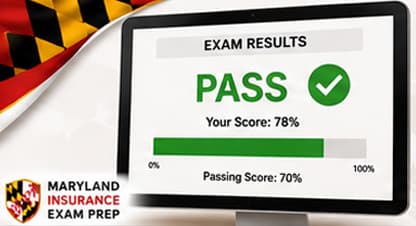
Maryland removed mandatory pre-licensing hours effective October 1, 2024. Many candidates interpret that as a light exam. Prometric still tests the full content outline; scores are pass/fail at 70%.
State law mistakes hurt more than memorization gaps
On the Life & Health combo, Insurance Regulation is about 30% of questions. Prep providers report that ignoring Maryland-specific statutes is the top content-related failure mode.
Exam-day errors are expensive and avoidable
Name/ID mismatches, late arrival, wrong exam codes, and prohibited items in the testing room can end your sitting before you finish—or force a paid retake after a 4-day wait.
Official links & contacts
After October 2024, pre-licensing is not required to schedule—but the exam difficulty did not change. Plan accordingly.
- Register & schedule (Prometric)
Create a candidate profile and book a test center or remote exam.
- Maryland Insurance Administration (Prometric hub)
Exam codes, scheduling steps, and MIA exam updates.
- MIA — Producer licensing overview
State requirements, fees, and application instructions.
Mistakes by category
Study habits, registration, test-day behavior, and retake traps.
Study & preparation
Most failures happen before test day—especially since Maryland ended mandatory pre-licensing in October 2024.
Skipping study because pre-licensing is not required
What goes wrong: Candidates assume no classroom hours means an easy exam. The test is still a full Prometric licensing exam with hundreds of outline objectives.
How to avoid: Treat self-study as required. Use timed practice until you consistently score at or above 70% on representative question sets.
Ignoring Maryland-specific regulation (~30% of combo exam)
What goes wrong: National-only courses leave gaps on twisting, rebating, replacement, MIA authority, and unfair trade practices—heavily tested on Maryland exams.
How to avoid: Block dedicated study time for state law. If the stem mentions Maryland or a producer duty, assume state rules unless the question says otherwise.
Not studying from the official content outline
What goes wrong: Reading textbooks cover-to-cover wastes time on low-weight chapters while missing high-weight sections like regulation and medical plans.
How to avoid: Download the Prometric outline for your exact exam code (2030 combo, 2027 Life, 2024 Health) and match study hours to question percentages.
Avoiding timed practice exams
What goes wrong: Untimed chapter quizzes build false confidence. On exam day, pacing collapses—especially on the 130-question Life & Health combo (150 minutes).
How to avoid: Take full-length timed simulations. Aim for steady progress without leaving a long tail of unanswered questions.
Scheduling the real exam too early
What goes wrong: Booking Prometric before practice scores stabilize leads to a $62 retake and a 4-day minimum wait before you can sit again.
How to avoid: Schedule only after several timed practices at or above 70%. Exam fees are non-refundable.
Registration & exam day logistics
Procedural errors can cost your sitting before you answer question one.
Name or ID does not match registration
What goes wrong: Prometric requires ID that exactly matches your profile and confirmation. A nickname, missing middle initial, or expired license can block check-in—treated as a missed appointment.
How to avoid: Update your Prometric profile before scheduling. Bring non-expired U.S. government photo ID with a signature. See our what-to-bring checklist.
Arriving late to the test center
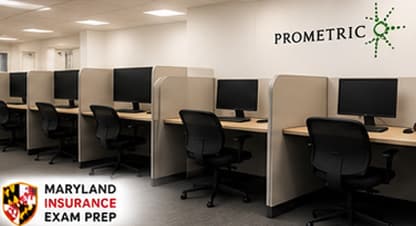
What goes wrong: Prometric asks you to arrive 30 minutes early. Late arrival can forfeit the appointment and your exam fee.
How to avoid: Scout the center address the week before. Plan traffic and parking; arrive early, not on time.
Registering for the wrong exam code
What goes wrong: Maryland uses separate codes (e.g., 2030 combo vs 2027 Life only). The fee is non-refundable and non-transferable if you pick the wrong test.
How to avoid: Confirm your intended license lines with the MIA or your employer, then select the matching code on prometric.com/maryland/insurance.
Bringing prohibited items to the testing room
What goes wrong: Phones, watches, notes, or bags in the testing area can end your exam under Prometric security rules.
How to avoid: Bring only ID and confirmation; store everything else in the locker. Eat before check-in—food is not allowed in the room.
Skipping ProProctor setup (remote exams)
What goes wrong: Remote candidates fail system checks, have unstable internet, or violate environment rules and cannot start.
How to avoid: Run Prometric’s system check and install ProProctor before exam day. Use a private, quiet space with a laptop or desktop—not a tablet.
During the exam
Test-taking habits that cost points even when you know the material.
Misreading BEST, EXCEPT, and NOT in the stem
What goes wrong: The most common in-exam error is answering the opposite of what was asked. Prometric intentionally uses qualifier language.
How to avoid: Cover the answer choices, read the stem twice, and underline the qualifier before you look at options.
Spending too long on one question
What goes wrong: Maryland exams are timed. Getting stuck on one scenario steals time from easier points later.
How to avoid: Pick an answer, mark for review if available, and move on. Return with leftover time rather than burning minutes early.
Assuming national rules for Maryland scenarios
What goes wrong: When a question references Maryland producers, the MIA, or state statutes, national defaults are often wrong.
How to avoid: If Maryland is named, apply state regulation. If no state is named, use general insurance principles from the outline.
Confusing look-alike products and provisions
What goes wrong: Term vs permanent life, HMO vs PPO, Medigap vs Advantage, and similar policy provisions blur under pressure.
How to avoid: Use comparison charts during study and drill scenario questions that force you to choose between two close products.
Second-guessing without evidence
What goes wrong: Changing answers from correct to incorrect on a gut feeling is a common post-exam regret.
How to avoid: Only change an answer if you recall a specific rule or fact—not because another choice “sounds better.”
Leaving questions blank
What goes wrong: There is no penalty for guessing on typical multiple-choice licensing exams, but blanks are guaranteed wrong.
How to avoid: Eliminate two distractors when you can, then make your best selection and flag for review.
After a failed attempt
Retakes are common—avoid compounding the first mistake.
Retaking before the waiting period
What goes wrong: Maryland candidates must wait at least 4 days before scheduling a retake. Eligibility resets after a fail.
How to avoid: Use the waiting period to study missed outline sections from your score report or practice data—not the same cram method.
Repeating the same study plan
What goes wrong: Retaking with only general review rarely fixes weak subdomains that caused the first fail.
How to avoid: Focus on your lowest-weighted outline areas and Maryland regulation. Use weak-area quizzes and timed sets.
Related exam guide pages
Practice your hardest topics in the app
Maryland Insurance Exam tracks performance by blueprint subdomain and can generate AI quizzes focused on topics you miss most.
More exam guides
Explore other Maryland licensing topics

Hardest Maryland Insurance Exam Topics
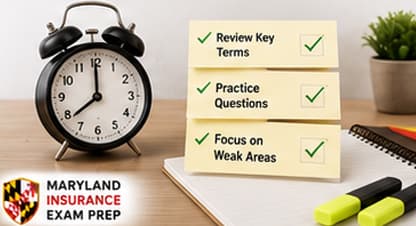
Last-Minute Study Tips

How to Pass on Your First Attempt
How to Get a Maryland Insurance License

Maryland Life & Health Exam Requirements

Maryland Insurance Exam Cost
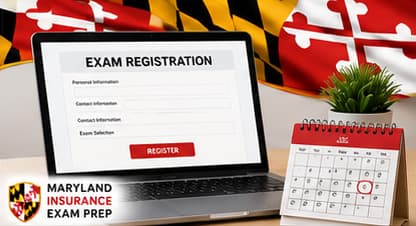
Maryland Insurance Exam Registration

Where to Take the Maryland Insurance Exam
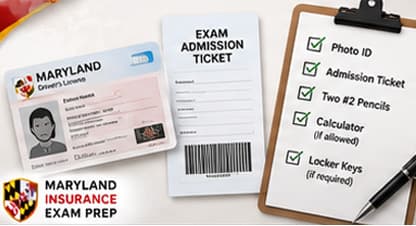
What to Bring to the Exam
Exam Format & Passing Score
Prometric Testing Centers in Maryland
Free Maryland Practice Test
Maryland Insurance Exam Questions
Maryland Life & Health Study Guide
Exam Readiness Calculator
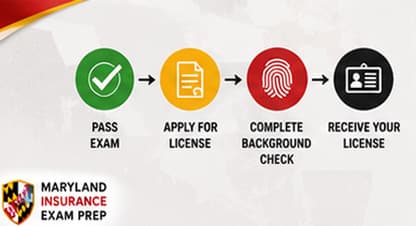
Next Steps After Passing the Exam
Applying for Your Maryland Insurance License

Background Check Requirements

Continuing Education Requirements
Ready to test your knowledge?
Try a short practice set with Prometric-style questions and instant feedback.
Maryland Insurance Exam is an independent exam prep platform and is not affiliated with Prometric or the Maryland Insurance Administration. Requirements and fees change—confirm current rules with the Maryland Insurance Administration and Prometric before you register.